When we were developing notification sounds for the Wolt Merchant app, we hit an early problem. The brief was to create several different sets of sounds so that partner venues — the restaurants and shops that receive and fulfil orders through Wolt — could choose a set that suited their environment. Good idea in principle. But without a clear framework for what those sets should actually be, we were designing in the dark.
What should the sets be called? What should distinguish them from each other? How do you design sounds that feel right for a busy restaurant kitchen versus a quiet neighbourhood café — and how do you explain those differences to a client in a workshop?
We didn't have answers to those questions at the start. What we did have was a series of workshops with the Wolt team, and in those workshops something useful started to emerge.
The quadrant
As we talked through the kinds of venues that use the Wolt Merchant app, two variables kept coming up. The first was order frequency — how busy the venue is, how often notifications arrive. The second was environmental noise — how loud and bustling the space itself is. A high-end restaurant at lunch service is noisy and frequent. A small boutique is quiet and receives orders rarely. A busy pharmacy is noisy but may have infrequent orders.
Once we named these two axes, the rest fell into place. We drew a quadrant.
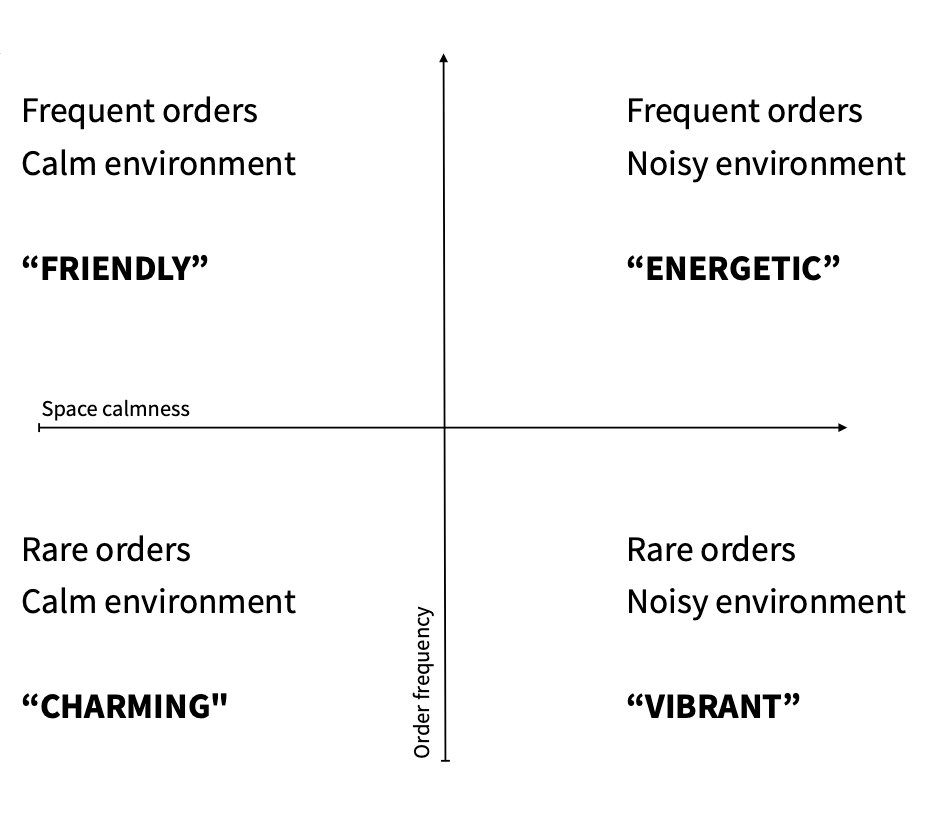
Four quadrants. Four archetypes. Four sound sets:
What made the quadrant so useful wasn't just the categories themselves — it was that it gave everyone in the room a shared language. Designers knew what they were designing for. The Wolt team could immediately picture the venues in each quadrant. Feedback became specific and meaningful. When a sound felt too aggressive for "Charming" or too gentle for "Energetic", we all understood exactly why.
A framework like this doesn't constrain creativity — it focuses it. It turns a vague brief ("make some different sets") into a set of clear, testable design problems.
The urgency problem
The quadrant solved one challenge. A second one was waiting for us: how do you communicate urgency through sound — without crossing into alarm?
For a partner venue, missing an incoming order is bad. Every order is revenue. Merchants genuinely do not want to miss notifications. But the reality of a working kitchen or shop is that the first notification sometimes gets missed — staff are busy, it's loud, attention is elsewhere.
So we designed a three-stage escalation system. The first notification is gentle — the standard sound for that venue's chosen set. If it goes unacknowledged, the second notification has a little more character, a little more presence. If that too is missed, the third and final notification has the most urgency of all.
The interesting design constraint was that even the third sound — the final call — could not feel like an alarm. No one's life is at stake. The stakes are real for the merchant, but they are commercial stakes, not emergency stakes. The sound needed to say "please, this really needs your attention now" without saying "danger". Finding that line — urgent but not alarming, insistent but not anxious — was one of the most interesting challenges in the whole project.
Sounding like Wolt
There was a third consideration running through all of this. By the time we worked on the Merchant app, Wolt already had an established sound identity from the Consumer app notification sounds we had designed in 2019. The Merchant sounds needed to be new — different enough to suit a completely different use context — but they also needed to sound like Wolt.
Generic notification sounds were not an option. The sounds had to carry the same sonic DNA as the consumer app: the same palette, the same character, the same sense of considered craftsmanship. A merchant hearing a Wolt notification should recognise it as Wolt, even if they've never consciously thought about why.
Below are three examples from the "Friendly" category — calm environment, frequent orders. You can hear the escalation: a new order arriving, then a reminder if it goes unacknowledged, then the final urgency prompt.
Listen to how the character shifts across the three sounds — the same family, the same voice, but with a gradually increasing sense of presence. That's the escalation system in action.
What the framework taught us
The quadrant was born in a workshop, almost by accident, out of a conversation about how venues actually differ from each other. That's often how the most useful design tools emerge — not from a brief, but from paying close attention to what the problem is actually asking.
The lesson I take from it: when a brief feels underspecified, resist the urge to start designing immediately. Spend time understanding the use context in depth. Find the variables that actually matter. Build a framework. Then design.
The sounds will be better for it — and so will the conversations with your client.